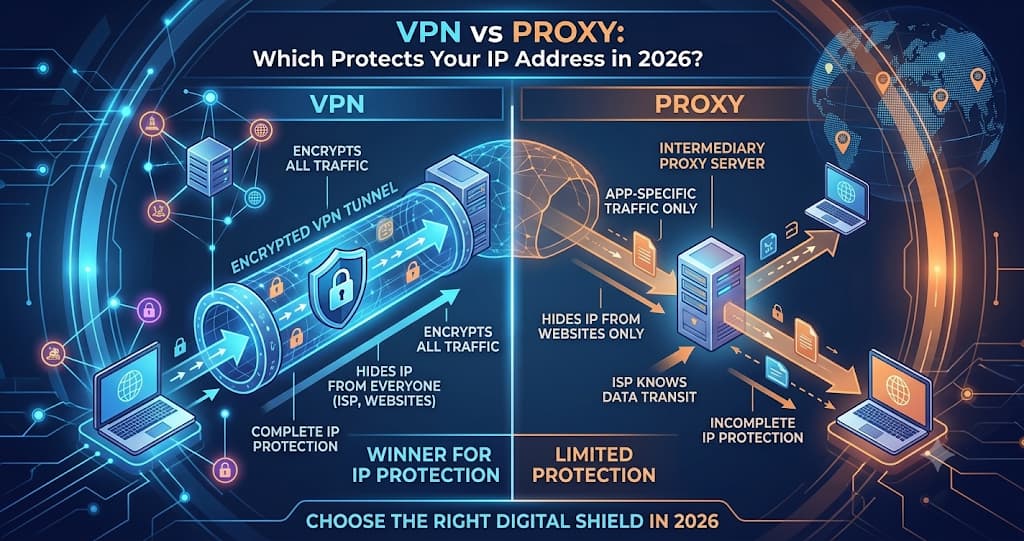
Both a VPN and a proxy can change your IP address, but only one actually protects what you send. Here's the real difference and which one fits your situation.
A proxy and a VPN both promise to change your IP address, and from the outside they can look like the same thing. Type in a server, your IP shifts, job done. But underneath, they work in very different ways, and that difference decides whether your data is actually protected or just rerouted.
This guide breaks down exactly what separates the two, so you can pick the right one instead of guessing.
Quick Answer: A VPN encrypts your entire connection and routes it through a secure server, hiding your IP and protecting your data from anyone watching, including your internet provider. A proxy only reroutes traffic for a specific app or browser, usually without encryption, which hides your IP but leaves your data exposed. For most privacy needs, a VPN is the stronger choice.
The Core Difference in One Sentence
A VPN protects your whole connection. A proxy protects your IP address for a specific task, and often nothing else.
That single distinction explains almost every other difference between them.
How a VPN Actually Works
When you connect to a VPN, it creates an encrypted tunnel between your device and the VPN server. Every app on your device sends traffic through that tunnel. Your internet provider, anyone on public Wi-Fi, and the websites you visit all see the VPN server's IP address, not yours, and none of them can read what you are sending because it is encrypted.
This system-wide coverage is what makes a VPN reliable. You do not have to configure each app individually. Turn it on, and everything is protected.
How a Proxy Actually Works
A proxy sits between your specific app, often just your browser, and the internet. It forwards your requests and returns responses, so the website sees the proxy's IP instead of yours. That part matches a VPN.
The difference is what happens to your data along the way. Most proxies do not encrypt your traffic. Your internet provider can still see exactly what you are doing, and if the proxy itself is untrustworthy, it can see everything too, including passwords typed into unencrypted sites.
Proxies also typically apply to one app at a time, not your whole device.
Side-by-Side Comparison
VPNProxyHides your IP | Yes | Yes
Encrypts your data | Yes | Usually no
Covers your whole device | Yes | Usually one app only
Speed | Fast on modern protocols | Fast, but often unreliable
Setup | One app, one toggle | Per-app configuration
Best for | Daily privacy, public Wi-Fi | Quick, low-stakes IP changes
Trust required | High, choose carefully | High, but often overlooked
Encrypts your data | Yes | Usually no
Covers your whole device | Yes | Usually one app only
Speed | Fast on modern protocols | Fast, but often unreliable
Setup | One app, one toggle | Per-app configuration
Best for | Daily privacy, public Wi-Fi | Quick, low-stakes IP changes
Trust required | High, choose carefully | High, but often overlooked
Before and After: What Changes When You Switch
Using a proxy for daily privacyUsing a VPN insteadPasswords on public Wi-Fi | Exposed if unencrypted | Protected by encryption
Coverage | Browser only, other apps exposed | Entire device
ISP visibility | Can see all traffic content | Can only see you are using a VPN
Reliability | Often slow, frequently down | Consistent uptime with paid providers
Coverage | Browser only, other apps exposed | Entire device
ISP visibility | Can see all traffic content | Can only see you are using a VPN
Reliability | Often slow, frequently down | Consistent uptime with paid providers
Someone using a proxy on public Wi-Fi for banking or shopping is taking on real risk without realizing it. A VPN closes that gap entirely.
When a Proxy Is Actually the Right Tool
Proxies are not useless. They have a real, narrow purpose.
- Quickly checking how a webpage looks from another country, with no sensitive data involved
- Bypassing a simple IP-based block for a single browsing session
- Web scraping or automated tasks where a team specifically wants app-level IP rotation
In these cases, you are not sending anything sensitive, so the lack of encryption matters less. Use a proxy when the task is low-stakes and temporary.
When You Should Always Choose a VPN Instead
- Banking, shopping, or logging into any account
- Using public Wi-Fi at a cafe, airport, or hotel
- Streaming or browsing where you want your whole device protected
- Any situation involving passwords, personal data, or financial information
If real privacy or security is the goal, a VPN is the tool built for it. A proxy simply was not designed to handle this level of protection.
VPN vs Proxy for Users in California
California's data privacy laws give residents strong rights over how companies handle their information, but that protection does not extend to what a proxy provider does with your unencrypted traffic. For California users doing anything beyond casual browsing, a VPN with an audited no-logs policy is the safer standard.
What New York Users Should Choose
Given how much of New York runs on public Wi-Fi across the subway and cafes, the encryption gap in proxies becomes a real daily risk. A VPN is the practical choice for anyone connecting on networks they do not control.
VPN or Proxy for London Users
UK users reaching for region-specific content often start with a proxy because it feels quick. For anything beyond casual, low-stakes browsing, a VPN's encryption is worth the extra step of choosing a provider, especially one transparent about its data handling.
What Toronto Users Need
With shared building Wi-Fi common across Toronto's condos, a proxy's lack of encryption leaves more exposed on a network you do not fully control. A VPN adds the protection layer that a proxy was never built to provide.
The One Mistake People Make Most Often
Assuming that because both tools change your IP, they offer the same protection. This is the single most common misunderstanding, and it is the one that leads people to use a free proxy for something sensitive, thinking they are covered the way a VPN would cover them.
If you remember one thing from this guide, remember this: hiding your IP and protecting your data are two different jobs. A VPN does both. A proxy usually does only the first.
For the full range of ways to hide your IP beyond these two, see our guide on how to hide your IP address, and if you are choosing a specific provider, our breakdown of the best VPN to hide your IP covers exactly what to look for.
Frequently Asked Questions
Can a proxy hide my IP address as well as a VPN?
It can hide your IP for the app it covers, but it does not encrypt your data the way a VPN does. If IP hiding is your only goal for a low-stakes task, a proxy works. For anything sensitive, a VPN is the safer choice.
It can hide your IP for the app it covers, but it does not encrypt your data the way a VPN does. If IP hiding is your only goal for a low-stakes task, a proxy works. For anything sensitive, a VPN is the safer choice.
Is a proxy faster than a VPN?
Sometimes, since it skips encryption overhead. But proxies are also often overcrowded or unreliable, especially free ones, which can make them slower in practice than a well-run VPN.
Sometimes, since it skips encryption overhead. But proxies are also often overcrowded or unreliable, especially free ones, which can make them slower in practice than a well-run VPN.
Do I need both a VPN and a proxy?
Most people only need a VPN, since it covers the use cases a proxy handles and adds encryption on top. A proxy is worth adding only for specific tasks like web scraping where app-level control matters.
Most people only need a VPN, since it covers the use cases a proxy handles and adds encryption on top. A proxy is worth adding only for specific tasks like web scraping where app-level control matters.
Is a free proxy safe to use for browsing?
Free proxies often lack encryption and sometimes log or inject content into your traffic. They are reasonable for quick, low-stakes checks but risky for anything involving accounts or personal data.
Free proxies often lack encryption and sometimes log or inject content into your traffic. They are reasonable for quick, low-stakes checks but risky for anything involving accounts or personal data.
Which one should I use on public Wi-Fi?
A VPN. Public Wi-Fi is exactly the situation where encryption matters most, since anyone on the same network could potentially see unencrypted traffic passing through a proxy.
A VPN. Public Wi-Fi is exactly the situation where encryption matters most, since anyone on the same network could potentially see unencrypted traffic passing through a proxy.
Does a VPN cost more than a proxy?
Many proxies are free, while quality VPNs typically charge a subscription. The cost buys you encryption, broader device coverage, and generally more reliable service.
Many proxies are free, while quality VPNs typically charge a subscription. The cost buys you encryption, broader device coverage, and generally more reliable service.
Can websites tell if I am using a proxy or a VPN?
Some websites can detect both, since certain IP ranges are known to belong to proxy or VPN services. Neither guarantees you will bypass every detection system.
Some websites can detect both, since certain IP ranges are known to belong to proxy or VPN services. Neither guarantees you will bypass every detection system.
Is a VPN overkill for just changing my IP for one website?
Not necessarily. Since a VPN protects your whole connection with one toggle, it is often just as simple to use for a single task as setting up a proxy, with the added benefit of encryption.
Not necessarily. Since a VPN protects your whole connection with one toggle, it is often just as simple to use for a single task as setting up a proxy, with the added benefit of encryption.
Final Thoughts
A proxy and a VPN both change your IP address, but only a VPN protects what you actually send once that IP is changed. For daily privacy, public Wi-Fi, or anything involving passwords and personal data, a VPN is the clear choice. Save the proxy for quick, low-stakes tasks where encryption was never the point.