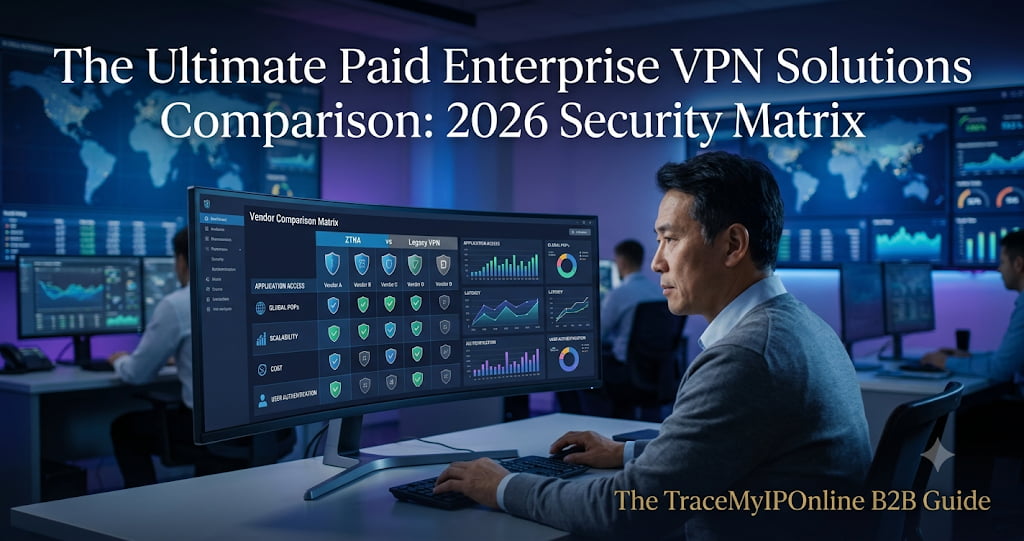
Are your remote employees connecting through a vulnerability? In 2026, legacy consumer-grade VPNs expose corporate networks to massive, AI-driven risks. We break down the ultimate paid enterprise VPN solutions comparison, analyzing top B2B providers like Cisco, Fortinet, and Zscaler to help you implement Zero Trust Network Access (ZTNA) and secure your hybrid workforce.
In the 2026 digital landscape, the distinction between a standard consumer VPN and a dedicated enterprise-grade security solution is the difference between a simple padlock and a biometric bank vault. As hybrid work solidifies globally, relying on free or basic virtual private networks is no longer just a performance issue; it is a critical liability. Corporate data breaches are costing millions, and the primary entry point is almost always an unsecured or poorly authenticated remote connection.
A comprehensive paid enterprise VPN solutions comparison reveals that modern organizations are rapidly abandoning legacy, full-tunnel VPNs in favor of Zero Trust Network Access (ZTNA) and comprehensive Secure Access Service Edge (SASE) platforms. According to recent cybersecurity findings, 81% of organizations plan to implement Zero Trust by 2026, while 65% are planning to replace their legacy VPN services entirely within the next year. If you haven't upgraded your remote infrastructure to match modern threat intelligence, your corporate IP masking and access strategy is already obsolete.
"We don't buy VPNs anymore; we invest in identity-based access perimeters. In 2026, if a user's connection cannot be dynamically verified against their device posture, IP reputation, and geo-location in real-time, they shouldn't touch the corporate network. Paid enterprise solutions are the only way to programmatically enforce this." — Lead Cybersecurity Architect, TraceMyIPOnline.
Why B2B Demands Dedicated Enterprise Proxies and ZTNA
Consumer VPNs are fundamentally designed to hide a user's IP address from their internet service provider (ISP) and bypass regional content restrictions. Enterprise solutions do the exact opposite for the corporate network: they provide absolute visibility, granular control, and compliance logging to the IT administration.
When a remote worker connects via a paid B2B solution, the system doesn't just encrypt the data tunnel. It authenticates the user's identity, checks the device for latent malware, verifies the origin IP address, and limits access strictly to the specific applications the user is authorized to use. This principle of "least privilege" is vital. In a traditional VPN, once a hacker compromises a user's credentials, they are on the network and can move laterally to access sensitive databases. ZTNA platforms broker sessions on a per-application basis, erasing that lateral-movement risk entirely.
Furthermore, the threat landscape has accelerated. The Zscaler 2026 VPN Risk Report highlights that 61% of organizations have encountered AI-enabled attacks. Because AI can iterate and adapt at machine speed, 54% of organizations admit that taking a week or more to patch critical VPN vulnerabilities leaves them dangerously exposed. You need a proactive, centrally managed solution to survive.
Before vs. After: Implementing Paid Enterprise VPNs
Security Threat | Traditional Legacy VPN (Before) | Enterprise ZTNA/SASE Solution (After)Compromised Credentials | Hacker gains full, lateral network access. | Access instantly blocked by MFA, device posture checks, and IP verification.
Ransomware Infection | Malware spreads laterally across the internal network. | Infection isolated immediately via strict micro-segmentation.
AI-Driven Intrusions | Traffic is opaque; 70% have no visibility into AI threats. | Real-time AI-powered monitoring intercepts malicious payloads at the edge.
Data Compliance (HIPAA) | Fails audit due to lack of central logging and control. | Passes audit with comprehensive SIEM integration and granular reporting.
Ransomware Infection | Malware spreads laterally across the internal network. | Infection isolated immediately via strict micro-segmentation.
AI-Driven Intrusions | Traffic is opaque; 70% have no visibility into AI threats. | Real-time AI-powered monitoring intercepts malicious payloads at the edge.
Data Compliance (HIPAA) | Fails audit due to lack of central logging and control. | Passes audit with comprehensive SIEM integration and granular reporting.
Programmatic Geo-Targeted Deployment Use Cases
Enterprise VPN deployment strategies vary heavily based on regional regulatory requirements, industry-specific compliance, and operational demands. Here is how different corporate hubs are evaluating their paid VPN solutions in 2026.
Healthcare Compliance: Boston Medical Networks
For major healthcare institutions in Boston managing highly sensitive patient data, HIPAA compliance is the absolute baseline. When comparing enterprise proxy solutions, these organizations require strict audit logging and uncompromising data-in-transit encryption. Providers like Cisco Secure and Palo Alto Prisma Access are heavily favored here because their ZTNA architectures ensure that even IT administrators cannot view unencrypted patient data, strictly segmenting network access based on precise medical staff roles and shifts.
Financial Sector Security: London Trading Desks
In the high-stakes financial hubs of London, raw speed and absolute security are equally paramount. Traditional VPNs introduce far too much latency for high-frequency trading algorithms and live market applications. The paid comparison here focuses on hardware-accelerated VPN concentrators and private global backbone routing. Solutions like Fortinet's FortiGate appliances are often deployed locally to create ultra-low latency, heavily encrypted tunnels directly to stock exchanges, ensuring transactions are executed without delay while maintaining bank-grade encryption.
Remote Engineering: Seattle Tech Corridors
Seattle-based tech enterprises manage thousands of remote developers who need secure, high-speed access to proprietary source code and distributed cloud-native environments (AWS, Azure, Google Cloud). These organizations are leading the charge towards SASE platforms like Zscaler Private Access (ZPA). Instead of routing all traffic back to a central headquarters (a performance-killing process known as hairpinning), Zscaler acts as a cloud-native proxy. It securely connects developers directly to cloud applications without exposing the internal corporate network to the public internet.
During internal security audits, administrators in these environments may notice unusual outbound traffic. Before blaming the enterprise VPN architecture, it is crucial to verify the endpoints. For instance, if an insider threat is suspected, HR or IT might need to find the IP address of a Discord user leaking corporate data to cross-reference with centralized VPN access logs.
Logistics and IoT: Chicago Distribution Hubs
Chicago's massive logistics networks are not just connecting human employees; they are connecting thousands of IoT devices, autonomous warehouse robots, and remote handheld scanners. Paid enterprise solutions in this sector are evaluated on their ability to manage lightweight VPN clients on low-power devices without draining batteries or causing handshake timeouts. Highly customized OpenVPN deployments or specialized IoT gateways are frequently used to secure continuous data streams from delivery fleets directly back to centralized ERP systems.
If a dispatcher notices an anomaly—such as a driver's login occurring from an impossible geographical location—they might cross-reference internal logs and even find the IP address from an Instagram message if social engineering or phishing is suspected in the initial breach. TraceMyIPOnline provides the foundational lookup tools to confirm these IP anomalies before escalating to the enterprise firewall team.
The 2026 Paid Enterprise VPN Solutions Comparison Matrix
Choosing the right vendor requires balancing stringent security features, per-user pricing, and existing infrastructure compatibility. Before initiating a costly, organization-wide deployment, ensure you audit your current network performance. You can review our Enterprise VPN Performance Benchmarks to understand baseline throughput and latency requirements.
Here is a comparison of the top enterprise players dominating the 2026 B2B security market:
Vendor / Platform | Best For (2026 Focus) | Architecture Type | Estimated Cost (Per User/Mo) | Key 2026 AdvantageZscaler Private Access | Cloud-Native Workforces, Global Teams | Cloud Proxy / SASE | $12 - $20+ | Erases lateral-movement risk by abandoning the "one big tunnel" concept.
Cisco Secure Client | Large Enterprises, Legacy Active Directory | ZTNA / SASE | $10 - $18+ | Proven scale and contract-ready security for public-sector and enterprise teams.
Fortinet FortiGate/Client | Hardware/Firewall Integration (On-Prem) | Firewall/VPN Concentrator | Hardware + License | Massive on-premise performance; integrates with Hybrid Mesh Firewalls.
NordLayer (B2B) | SMEs, Growing Teams, Startups | Cloud VPN / ZTNA | $7 - $12 | Fast setup, balanced power, and transparent renewals for smaller businesses.
TraceMyIPOnline | Initial IP Audit, Network Forensics | Web-Based Analytics | Free Tier Available | Essential for verifying the true origin IP of access attempts before configuring firewalls.
Cisco Secure Client | Large Enterprises, Legacy Active Directory | ZTNA / SASE | $10 - $18+ | Proven scale and contract-ready security for public-sector and enterprise teams.
Fortinet FortiGate/Client | Hardware/Firewall Integration (On-Prem) | Firewall/VPN Concentrator | Hardware + License | Massive on-premise performance; integrates with Hybrid Mesh Firewalls.
NordLayer (B2B) | SMEs, Growing Teams, Startups | Cloud VPN / ZTNA | $7 - $12 | Fast setup, balanced power, and transparent renewals for smaller businesses.
TraceMyIPOnline | Initial IP Audit, Network Forensics | Web-Based Analytics | Free Tier Available | Essential for verifying the true origin IP of access attempts before configuring firewalls.
Note: Pricing spans a wide range. Low sticker prices can quickly vanish once you add dedicated gateways, static IPs, or premium 24/7 support. Always request a custom quote based on your specific topology.
B2B Security Statistics: 2026 Projections
To understand the urgency of migrating from legacy systems, consider these verified 2026 industry benchmarks:
- Zero Trust Adoption: 81% of organizations plan to implement zero trust architectures by 2026.
- VPN Replacement: By the end of 2025, 70% of new remote-access deployments will rely on ZTNA rather than legacy VPNs.
- The AI Threat Gap: 70% of organizations admit they have limited or zero visibility into AI-enabled threats moving over their current VPN infrastructure.
- Exploitation Speed: 22% of vulnerability-exploitation breaches directly targeted edge devices, including legacy VPN concentrators, marking a massive eightfold jump from previous years.
- Unpatched Vulnerabilities: 54% of IT teams report that it takes a week or more to patch critical VPN vulnerabilities, leaving a massive window for AI-accelerated attacks.
Frequently Asked Questions (FAQ)
1. What is the difference between a consumer VPN and an enterprise VPN?
Consumer VPNs prioritize user anonymity, bypassing geo-restrictions, and basic encryption. Enterprise VPNs prioritize corporate data protection, strict user authentication (MFA), granular access control (limiting users to specific apps), and total network visibility for IT administrators.
2. Is Zero Trust Network Access (ZTNA) replacing enterprise VPNs?
Yes, in a majority of corporate environments. ZTNA is the logical evolution of the enterprise VPN. Instead of granting access to the entire internal network once a user connects, ZTNA grants access only to specific, authorized applications on a per-session basis, continuously verifying the user's identity and device health.
3. How much does a paid enterprise VPN cost in 2026?
Costs vary heavily based on architecture and add-ons. Cloud-native SASE and ZTNA solutions typically range from $10 to $20+ per user per month. Hardware-based firewall VPNs (like Fortinet) require upfront physical appliance purchases plus ongoing software licensing fees.
4. Why is IP visibility so important for corporate security?
IP visibility is the foundation of identity verification. If you cannot trace the public IP of an access attempt back to a known corporate profile, a whitelisted geography, or a reputable ASN, you cannot trust the login, regardless of whether the password was correct.
5. How do legacy VPNs struggle against modern AI attacks?
Legacy VPNs often suffer from visibility blind spots; 1 in 3 organizations inspect 0% of encrypted VPN traffic. AI-driven attacks move at machine speed, exploiting these blind spots and unpatched vulnerabilities faster than human defenders can identify and quarantine the threat.
6. Can we use TraceMyIPOnline as an enterprise security tool?
TraceMyIPOnline serves as a vital preliminary diagnostic and forensic tool. IT administrators use it to instantly audit suspicious IPs, verify ASN reputation, and track geo-velocity anomalies before configuring complex, organization-wide rules in their primary SASE or firewall platforms.
7. What is "hairpinning" in network routing?
Hairpinning occurs in legacy VPN setups where remote user traffic is routed all the way back to a central corporate data center only to be sent back out to a cloud application (like Office 365). This causes severe latency. Modern SASE solutions fix this by routing users directly to cloud apps via edge proxies.
8. Should we completely rip out our old VPN today?
Not necessarily. Many enterprises adopt a hybrid approach. They keep legacy VPNs running for older, on-premise applications while seamlessly routing new cloud application traffic through modern ZTNA platforms. This phased approach prevents sudden security gaps.