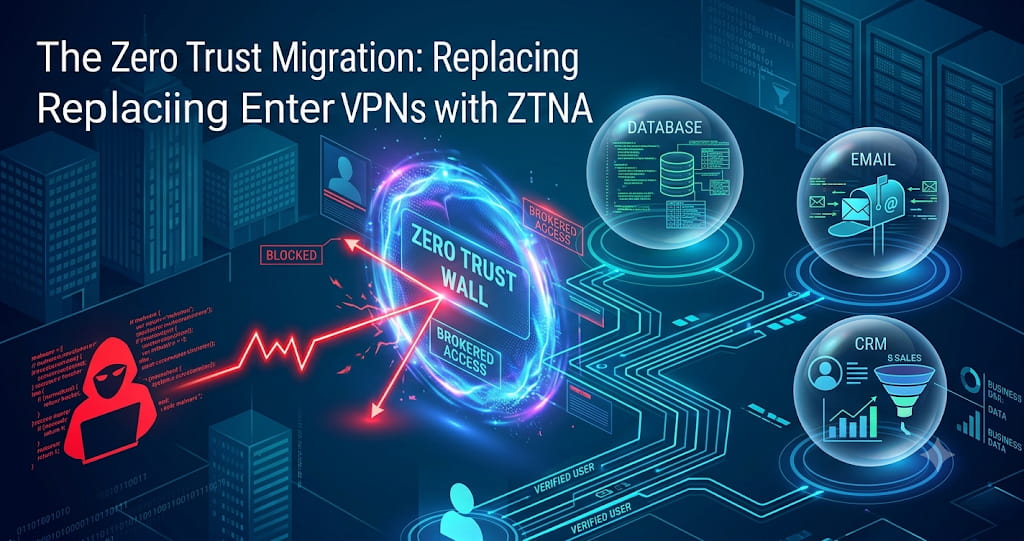
The traditional corporate network perimeter is officially obsolete. If your organization still grants remote employees broad network access via a legacy Enterprise VPN, you are heavily exposed to lateral movement ransomware attacks. In 2026, the cybersecurity industry has aggressively shifted to Zero Trust Network Access (ZTNA). Discover the critical differences between legacy VPNs and ZTNA, and why transitioning to an identity-driven, micro-segmented access model is now mandatory for modern enterprises.
For over two decades, the Enterprise VPN has been the undisputed king of remote corporate access. The concept was simple: authenticate a user at the edge of the network, create an encrypted tunnel, and drop them safely inside the corporate LAN. However, in 2026, this model of "implicit trust" is a critical cybersecurity vulnerability. When you use a traditional VPN, once a user is inside the network, they can largely see and interact with everything on that network segment. If a hacker steals an employee's VPN credentials, they gain the exact same broad lateral access, allowing them to quietly move from a compromised laptop to the central payroll database.
This fatal flaw has led to the rapid adoption of Zero Trust Network Access (ZTNA). ZTNA flips the legacy VPN model on its head. Instead of granting access to a network, ZTNA grants access to a specific application, and only after continuously verifying the user's identity and device posture. To understand the transition, network architects frequently use tools like an IP address lookup tool to audit their current VPN gateways, ensuring they have full visibility before migrating to a Zero Trust architecture.
"A legacy VPN is like giving someone the master key to your entire office building just because they need to use the bathroom. ZTNA is like giving them a digital keycard that only opens the bathroom door, and revokes their access the second they step out." — Lead Cloud Security Architect, TraceMyIPOnline.
The Core Difference: Network Access vs Application Access
The debate between an Enterprise VPN vs ZTNA comes down to micro-segmentation.
A Legacy Enterprise VPN connects a user's device directly to the corporate network. It provides a secure tunnel over the public internet, but once that tunnel ends at the firewall, the user is trusted.
A ZTNA platform is application-centric. It completely decouples application access from network access. The applications are hidden behind a cloud proxy. When an employee wants to access the CRM, the ZTNA platform verifies their MFA, checks if their laptop's antivirus is active, and then creates a secure, 1-to-1 connection only between the user and the CRM. The user never actually touches the underlying corporate network.
Before vs. After: The Zero Trust Migration
Security Control | Legacy Enterprise VPN (Before) | ZTNA / Zero Trust (After)Trust Model | "Trust, but verify at the door." | "Never trust, always verify continuously."
Visibility | User sees the entire network subnet. | User only sees the specific assigned application.
Lateral Movement | High risk. Malware can spread across the LAN. | Impossible. Applications are isolated from each other.
Device Posture | Often ignores the health of the connecting device. | Blocks access if the device lacks security patches.
Visibility | User sees the entire network subnet. | User only sees the specific assigned application.
Lateral Movement | High risk. Malware can spread across the LAN. | Impossible. Applications are isolated from each other.
Device Posture | Often ignores the health of the connecting device. | Blocks access if the device lacks security patches.
Programmatic ZTNA Deployment: Industry Use Cases (H2s)
Migrating from a VPN to ZTNA is not a one-size-fits-all process. Here is how major industries are tackling the transition in 2026.
Software Development: Seattle Tech Giants
In Seattle, tech companies employ thousands of remote developers accessing highly sensitive AWS and Azure source code repositories. Using a legacy VPN meant developers had access to far more infrastructure than necessary. By migrating to ZTNA, Seattle IT directors implement "Least Privilege Access." A front-end developer's ZTNA profile only allows connection to the front-end staging servers. If a threat hunter spots unusual traffic, they might investigate the source—perhaps needing to find the IP address from an Instagram message if a developer was socially engineered—knowing the ZTNA architecture has already contained the threat to a single app.
B2B Supply Chain: Atlanta Logistics Hubs
Atlanta's massive logistics firms rely on hundreds of third-party vendors and contractors. Giving these external partners standard VPN access is incredibly dangerous. ZTNA allows these firms to deploy "Clientless Access." Contractors log into a secure web portal and access specific inventory applications through their browser, without ever installing a VPN client or touching the Atlanta firm's internal network. To understand the legal necessity of securing these external connections, review our guide on Why Enterprise VPN Logs Are Mandatory for Compliance.
Remote Call Centers: Phoenix Customer Support
Phoenix-based customer support centers face the challenge of latency. Support agents use VoIP and cloud-based ticketing systems. Forcing this high-bandwidth traffic through a central legacy VPN gateway causes massive lag. Modern ZTNA platforms integrate natively with Secure Access Service Edge (SASE) backbones. By reviewing Enterprise VPN Performance Benchmarks, Phoenix IT teams utilize ZTNA to route agent traffic directly to the nearest cloud edge node, securing the connection while drastically reducing VoIP latency.
Financial Auditing: Chicago Banking Sector
Chicago financial institutions face strict SEC and FINRA audits. When an auditor or compliance officer requires remote access, they are granted a heavily monitored ZTNA profile. Every single action, packet, and application request is logged and analyzed. If an anomaly is detected, security teams can instantly sever the micro-tunnel. If the anomaly is traced to a potential insider threat communicating on unofficial channels, investigators might even attempt to find the IP address of a Discord user to build a comprehensive forensic timeline.
Top ZTNA & Next-Gen VPN Vendors (Competitor Table)
If your enterprise is ready to decommission its legacy hardware VPNs, these platforms are leading the 2026 ZTNA market.
Security Vendor | ZTNA Deployment Model | Core Advantage (2026) | Best ForZscaler Private Access (ZPA) | 100% Cloud-Native ZTNA | Complete decoupling of apps from the network. | Global Enterprises
Palo Alto Prisma Access | SASE with integrated ZTNA | Best-in-class deep packet inspection. | High-Security Sectors
Cloudflare Access | Edge-Network ZTNA | Ultra-fast clientless web application access. | Tech Startups & SaaS
Cisco Secure Access | Hybrid VPN/ZTNA | Smooth migration for existing Cisco hardware users. | Legacy Enterprises
TraceMyIPOnline | IP Intelligence | Pre-migration auditing of user IP footprints. | IT Architects
Palo Alto Prisma Access | SASE with integrated ZTNA | Best-in-class deep packet inspection. | High-Security Sectors
Cloudflare Access | Edge-Network ZTNA | Ultra-fast clientless web application access. | Tech Startups & SaaS
Cisco Secure Access | Hybrid VPN/ZTNA | Smooth migration for existing Cisco hardware users. | Legacy Enterprises
TraceMyIPOnline | IP Intelligence | Pre-migration auditing of user IP footprints. | IT Architects
2026 ZTNA Adoption Statistics
- Market Shift: Gartner reports that by the end of 2026, 75% of large enterprises will have completely replaced their legacy remote-access VPNs with ZTNA solutions.
- Breach Containment: Organizations utilizing ZTNA contain data breaches 40% faster than those relying on traditional perimeter firewalls.
- Ransomware Reduction: Implementing micro-segmentation via ZTNA reduces the success rate of lateral ransomware spread by over 80%.
Frequently Asked Questions (FAQ)
1. Is ZTNA just a new buzzword for a VPN?
No. While both provide secure remote access, their architecture is fundamentally different. A VPN connects a user to a network. ZTNA connects a user to an application, while keeping the network entirely invisible.
2. Can ZTNA completely replace my Enterprise VPN?
For remote worker access, yes. Most enterprises are actively decommissioning their remote-access VPNs in favor of ZTNA. However, Site-to-Site VPNs are still heavily used for connecting physical branch offices to data centers.
3. Does ZTNA require installing software on employee laptops?
It depends on the application. For web-based apps (like Salesforce), ZTNA can be "clientless," operating entirely through a secure browser. For accessing legacy on-premise servers (like RDP or SSH), a lightweight ZTNA agent is usually required on the endpoint.
4. How does ZTNA handle device security?
ZTNA performs Continuous Adaptive Risk and Trust Assessment (CARTA). Before granting access, the ZTNA agent checks if the laptop has the latest OS updates, active antivirus, and is connecting from a safe geographical IP location. If the device fails the posture check, access is denied, even if the password is correct.
5. What is the first step to migrate to ZTNA?
The first step is a comprehensive application audit. You cannot protect what you don't know exists. Use network mapping tools and TraceMyIPOnline to catalog every internal application, its hosting location, and exactly which user roles require access to it, before configuring your ZTNA policies.
Contact Us: admin@tracemyiponline.com | Website: https://www.tracemyiponline.com