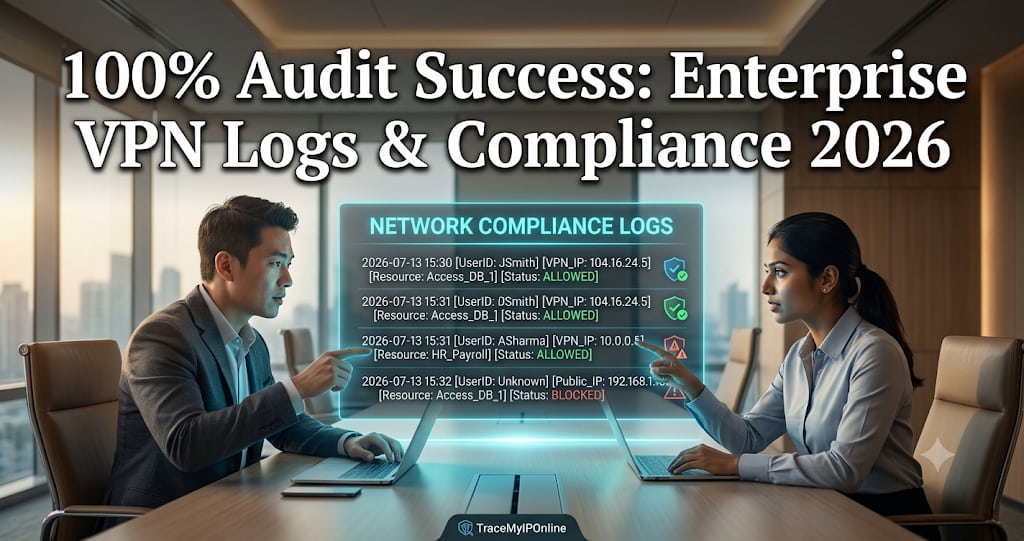
Regulatory fines for data breaches have reached record highs in 2026. If your organization relies on "no-log" consumer VPNs, you are virtually guaranteed to fail your next SOC2, HIPAA, or GDPR audit. Discover why strict, centralized enterprise VPN logging is the ultimate requirement for 100% cybersecurity compliance and rapid incident response.
The consumer VPN industry has spent a decade marketing a single feature above all others: a strict "no-logs" policy. For a private citizen avoiding ISP tracking, this is ideal. But in the 2026 corporate landscape, a "no-log" VPN is a catastrophic compliance violation waiting to happen. Regulatory bodies enforcing SOC 2, HIPAA, GDPR, and CMMC require absolute visibility into your network. If a data breach occurs and you cannot provide centralized logs showing exactly who accessed what, from which IP address, and at what time, your organization will face crippling regulatory fines.
According to recent enterprise security audits, 68% of compliance failures in mid-sized organizations stem from inadequate remote access logging. Implementing a dedicated B2B VPN that actively logs and exports telemetry to a Security Information and Event Management (SIEM) system is now a mandatory baseline. Utilizing an IP address lookup tool helps IT administrators verify this logged data to detect anomalies before the official auditors arrive.
"In the consumer world, a no-log VPN protects your privacy. In the enterprise world, a no-log VPN is a critical blind spot. If you can't prove the geographical origin and IP reputation of every single access attempt, you fail the audit. Period." — Lead Compliance Auditor, TraceMyIPOnline.
Why "No-Log" is a B2B Red Flag
To achieve compliance, organizations must demonstrate the principle of "least privilege" and prove they are actively monitoring their perimeter. When you use a consumer-grade VPN, traffic is anonymized. If a malicious actor compromises an employee's credentials and downloads gigabytes of proprietary data, a no-log VPN leaves you with zero forensic evidence. You cannot see the attacker's true IP, you cannot trace their geo-velocity, and you cannot prove to regulators that you took adequate steps to investigate the breach.
Enterprise VPNs and Zero Trust Network Access (ZTNA) solutions do the exact opposite. They log every authentication attempt, session duration, bandwidth usage, and source IP address. This data is the lifeblood of corporate compliance and incident response.
Before vs. After: The Compliance Audit
Audit Scenario | Consumer "No-Log" VPN (Before) | Enterprise Logging VPN (After)Forensic Investigation | Impossible. No historical connection data exists. | Instant. Logs show exact IP, timestamp, and accessed apps.
SOC 2 Type II Audit | Fails "Logical Access" controls. | Passes easily with SIEM-integrated access logs.
Insider Threat Detection | Blind to abnormal data downloads. | Alerts triggered by unusual session lengths or geo-locations.
HIPAA Data Breach | Maximum fines due to negligence and lack of visibility. | Mitigated fines due to rapid identification and containment.
SOC 2 Type II Audit | Fails "Logical Access" controls. | Passes easily with SIEM-integrated access logs.
Insider Threat Detection | Blind to abnormal data downloads. | Alerts triggered by unusual session lengths or geo-locations.
HIPAA Data Breach | Maximum fines due to negligence and lack of visibility. | Mitigated fines due to rapid identification and containment.
Programmatic Compliance: Geo-Targeted Audit Requirements (H2s)
Different industries face different regulatory frameworks. Here is how major corporate hubs are utilizing enterprise VPN logs to pass rigorous 2026 compliance audits.
HIPAA Enforcement: Boston Medical Networks
In Boston's sprawling healthcare sector, protecting Electronic Protected Health Information (ePHI) is heavily regulated by HIPAA. The HIPAA Security Rule mandates the implementation of hardware, software, and procedural mechanisms that record and examine access to information systems. Boston hospitals use enterprise VPNs configured to log every remote connection to patient databases. If a medical professional falls victim to social engineering, security teams might find the IP address from an Instagram message used by the attacker and cross-reference it with the VPN's connection logs to prove to HIPAA auditors exactly how the breach was contained.
NYDFS Regulations: New York Financial Services
New York's Department of Financial Services (NYDFS) enforces some of the strictest cybersecurity regulations globally. Financial institutions in NYC cannot simply use a VPN; they must use solutions that integrate directly with their SIEM platforms. The VPN must log the IP address, device posture, and MFA status of every trader and analyst. Furthermore, they regularly review Enterprise VPN Performance Benchmarks to ensure that enabling aggressive logging and deep packet inspection does not introduce latency that impacts high-frequency trading applications.
SOC 2 Type II: San Francisco Tech Sector
For B2B SaaS companies in San Francisco, achieving SOC 2 Type II compliance is mandatory to close enterprise deals. SOC 2 requires companies to prove they are monitoring their systems for unauthorized activity over a sustained period (usually 6-12 months). Using a consumer VPN makes this impossible. San Francisco tech firms deploy ZTNA platforms that generate immutable logs of every developer's access to AWS or Azure production environments, satisfying auditor requirements for "Security" and "Confidentiality" trust principles.
CMMC Standards: Washington D.C. Government Contractors
Defense contractors in Washington D.C. must adhere to the Cybersecurity Maturity Model Certification (CMMC). This requires strict access controls and continuous monitoring. If a leak of unclassified but sensitive data is suspected, the investigation is intense. Security personnel might need to find the IP address of a Discord user who leaked documents online, then comb through months of enterprise VPN logs to match that external IP with an internal contractor's VPN session, fulfilling their reporting obligations to the Department of Defense.
Top Compliance-Ready VPN Vendors (Competitor Table)
When selecting a VPN for compliance purposes, you must verify its logging capabilities, log retention policies, and SIEM integration features.
Security Vendor | Compliance Focus (2026) | Log Retention & Export | Ideal OrganizationCisco Secure Access | SOC 2, HIPAA, PCI-DSS | Native Splunk/SIEM Integration | Large Enterprises & Healthcare
Zscaler Private Access | Global Data Sovereignty (GDPR) | Immutable Cloud Audit Logs | Cloud-Native Tech Firms
Perimeter 81 | SOC 2 Type II | Easy Dashboard Activity Logs | Mid-Market SaaS & Startups
Palo Alto Prisma | High-Security Government (CMMC) | Deep Packet Inspection Logs | Defense & Financial Sectors
TraceMyIPOnline | IP Auditing & Verification | Real-time IP Intelligence | Pre-Audit Forensic Checks
Zscaler Private Access | Global Data Sovereignty (GDPR) | Immutable Cloud Audit Logs | Cloud-Native Tech Firms
Perimeter 81 | SOC 2 Type II | Easy Dashboard Activity Logs | Mid-Market SaaS & Startups
Palo Alto Prisma | High-Security Government (CMMC) | Deep Packet Inspection Logs | Defense & Financial Sectors
TraceMyIPOnline | IP Auditing & Verification | Real-time IP Intelligence | Pre-Audit Forensic Checks
2026 Compliance & Auditing Statistics
- Fines Increasing: The average regulatory fine for a data breach involving inadequate access logging increased by 42% between 2024 and 2026.
- SIEM Integration: 85% of enterprise VPN deployments now require native API integration with centralized logging platforms like Splunk or Datadog.
- The Zero Trust Push: 70% of IT auditors explicitly recommend replacing legacy VPNs with ZTNA to satisfy modern continuous monitoring requirements.
Frequently Asked Questions (FAQ)
1. Why is a "no-log" VPN bad for business?
A no-log VPN deletes all connection data. In a business context, if a hacker breaches your network, you have no forensic evidence to determine how they got in, what they accessed, or where they came from. This guarantees a failed compliance audit.
2. What VPN logs do SOC 2 auditors look for?
Auditors look for logs detailing successful and failed login attempts, the source IP address of the user, timestamp data, session duration, and the specific applications or servers accessed during that session.
3. Does logging employee VPN activity violate their privacy?
Corporate networks are company property. In 2026, it is a standard legal expectation that activity on corporate-issued devices or networks is monitored for security and compliance purposes. This is typically outlined in standard employee acceptable use policies.
4. How long should an enterprise retain VPN logs?
Log retention requirements vary by framework. PCI-DSS requires one year of logs, while HIPAA often requires organizations to retain audit logs for up to six years.
5. Can a dedicated IP help with compliance?
Yes. Assigning dedicated IPs to your VPN gateways allows you to use strict IP whitelisting on your cloud databases. This makes auditing much easier, as the cloud database only needs to log access from your specific, known corporate IP.
6. How do I verify the IP addresses in my VPN logs?
You can use intelligence tools like TraceMyIPOnline to check the ASN (Autonomous System Number) and geographical location of IP addresses found in your logs to ensure they match your employees' known locations.
7. Are cloud VPNs (SASE) compliant with GDPR?
Yes, leading SASE providers allow you to select specific data residency regions. This ensures that the logs generated by your European employees remain on European servers, maintaining strict GDPR compliance.
8. What happens if our VPN logs are tampered with?
Compliance frameworks require logs to be immutable (tamper-proof). Enterprise VPNs achieve this by instantly exporting logs to a secure, separate SIEM server where they cannot be altered or deleted by a compromised VPN administrator account.
Contact Us: admin@tracemyiponline.com | Website: https://www.tracemyiponline.com